Table of Contents:
- Understanding the ‘Night-Time Privacy’ Limitation
- Key Performance Metrics for Specifying Mirror Film
- Strategic Applications in Commercial Facilities
- Installation and Project Management for Large-Scale Projects
- Conclusion: Making the Right Specification
- Frequently Asked Questions
- Related Posts from Window Film Depot
Understanding the ‘Night-Time Privacy’ Limitation
Specifying one way mirror film requires managing one of the most common and costly misconceptions: the expectation of 24/7 privacy. While the technology provides exceptional daytime privacy, its effectiveness is entirely dependent on lighting conditions. Understanding and communicating this limitation is fundamental to a successful project and a satisfied client.
Why the Mirror Effect Reverses at Night
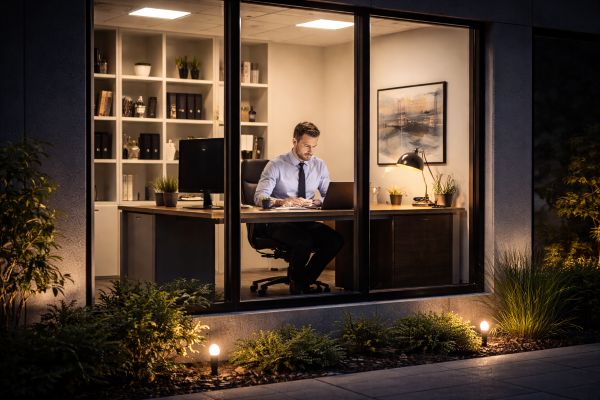
The same light differential that creates daytime privacy is also responsible for its reversal at night. Once the sun sets and interior lights are turned on, the inside of the building becomes significantly brighter than the exterior. This imbalance of light causes the film’s properties to flip.
The reflective surface, which faced outward to mirror the bright daytime sky, now reflects the brighter interior space back at the occupants. From the outside, the darker environment allows clear visibility into the illuminated interior. The window that was a mirror by day becomes a transparent pane of glass at night, completely compromising privacy. This is not a product flaw but a predictable outcome based on the physics of light and reflection.
Managing Client Expectations for 24/7 Privacy
For a project manager, the critical step is to address the night-time reversal effect with the client during the specification phase, not after installation. Clearly explaining that the term “one-way mirror” describes a daytime-only effect under specific lighting conditions prevents future disappointment and change orders.
Framing this conversation correctly is key. Position the film as a strategic daytime privacy and energy management tool, not an absolute 24-hour privacy solution. Setting this realistic expectation builds trust and reinforces your role as a knowledgeable consultant, ensuring the client understands precisely what they are investing in.
Alternative and Hybrid Solutions for Night-Time Needs
When a client requires guaranteed privacy after dark, the project scope must include a secondary solution. Relying solely on reflective window film for this purpose will not meet the client’s needs. Fortunately, several effective strategies can be layered with the film to provide a comprehensive, 24/7 solution.
- Conventional Window Treatments: The most straightforward solution is pairing reflective film with traditional coverings like blinds, shades, or curtains. During the day, the film provides privacy and solar control with an unobstructed view out. At night, the blinds are drawn for absolute privacy.
- Switchable Smart Film (PDLC): For high-tech spaces, Polymer Dispersed Liquid Crystal (PDLC) film offers an elegant solution. This film can be electronically switched from transparent to an opaque, frosted state, providing instant privacy on demand.
- Frosted and Decorative Films: In areas where a clear view is not necessary, such as bathroom windows or internal partitions, frosted films offer a superior solution. They obscure the view by diffusing light, ensuring complete privacy day and night while still allowing light transmission.
Key Performance Metrics for Specifying Mirror Film
To move from concept to professional specification, project managers must be familiar with key performance metrics. These data points, found on any reputable film’s technical sheet, are the language of performance. Understanding them is the first step in aligning a product with a client’s goals for privacy, energy management, and aesthetics. The objective is not to find the film with the single best number, but the one with the right balance for the project.
VLT (Visible Light Transmission): Controlling Brightness and Views
Visible Light Transmission measures the percentage of visible light that passes through the filmed glass. A lower VLT number means less light comes in, resulting in a darker interior and a stronger one way mirror film effect during the day.
For example, a film with a VLT of 15% will create significant daytime privacy but will also noticeably reduce natural light. Conversely, a film with a VLT of 35% will let in more light and offer a clearer view out, but the privacy effect will be less pronounced. The specification decision is a direct trade-off between the desired level of privacy and the client’s tolerance for a dimmer interior.
TSER (Total Solar Energy Rejected): Quantifying Energy Savings
Total Solar Energy Rejected is arguably the most critical metric for evaluating a film’s impact on energy efficiency. TSER measures the film’s ability to block solar energy, which includes visible light, ultraviolet (UV) light, and infrared (IR) radiation, the primary source of solar heat.
A higher TSER percentage indicates better heat rejection and greater potential for energy savings. By reducing solar heat gain, the film lessens the load on the building’s HVAC system, leading to lower operating costs and potentially contributing toward LEED credits. For a client concerned with ESG goals or high utility bills, a film with a high TSER is a powerful tool that provides a tangible forecast for return on investment.
VLR (Visible Light Reflectance): Balancing Aesthetics
Visible Light Reflectance quantifies how much visible light is reflected by the glass. This metric has two values: exterior (VLRe) and interior (VLRi). A high exterior reflectance is what creates the “mirror” appearance from the outside during the day.
While a high VLRe is necessary for daytime privacy, it dramatically alters the building’s façade. This requires careful consideration, especially for architecturally sensitive projects. A high interior reflectance can also create a mirror-like effect inside at night, which may be undesirable in some office settings. The key is to select a film that provides the necessary exterior privacy without creating an unwanted interior effect or clashing with the building’s design.
UV Rejection: Protecting Interior Assets
Ultraviolet Rejection measures the film’s effectiveness at blocking damaging UV rays, the leading cause of fading in furniture, flooring, and retail merchandise. Nearly all professional-grade solar control films, including one-way mirror films, block over 99% of UV radiation. Confirming this specification is crucial for protecting the long-term value of a building’s interior assets. For retail or museum projects, this single benefit can justify the entire investment.
Strategic Applications in Commercial Facilities
With a clear understanding of performance metrics, we can explore how these films are strategically applied across different commercial environments. The goal is to leverage the film’s properties to solve specific, tangible problems for the building owner and its occupants.
Enhancing Security in Office Buildings
For ground-floor offices and conference rooms, one way mirror film provides a critical layer of daytime privacy. It shields screens displaying sensitive information, protects the confidentiality of meetings, and deters opportunistic observation. This fosters a more secure and focused work environment for employees without eliminating natural light.
Improving Retail Storefront Glass
Retailers must attract customers with appealing displays while protecting merchandise from sun damage. A reflective window film with a moderate VLT can significantly cut down on harsh glare, making it easier for customers to see products. The high UV rejection protects valuable stock from fading, while the reflective exterior can provide a sleek, uniform look to a multi-tenant retail façade.
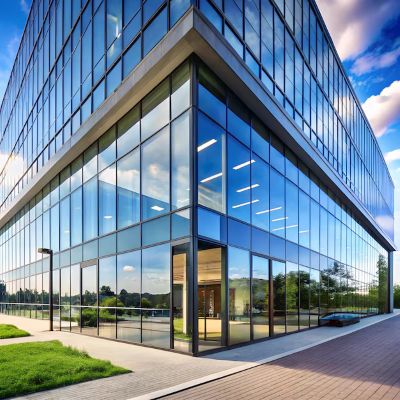
Managing Heat on Large Curtain Wall Systems
Buildings with extensive glass curtain walls are susceptible to massive solar heat gain, leading to uncomfortable hot spots and high cooling costs.
Retrofitting these large glass expanses with a high-TSER mirror film is a cost-effective engineering solution.
It can dramatically improve the building’s energy envelope, often delivering a return on investment in just a few years through verified energy savings.
Securing Sensitive Areas in Institutions
Schools, hospitals, and government buildings often contain areas requiring enhanced privacy, such as administrative offices, counseling centers, or security observation rooms. This type of privacy window film for business allows staff to monitor public spaces without being seen, enhancing situational awareness. It creates confidential spaces for students or patients while still allowing a visual connection to the outside.
Installation and Project Management for Large-Scale Projects
Specifying the correct window film is only half the battle. The success of a window film project hinges on meticulous planning and professional execution during the installation phase. Overlooking these steps can compromise performance, void the warranty, and negate the investment.
Pre-Installation: Site Surveys and Glass Compatibility
A comprehensive site survey is a non-negotiable first step before ordering any film. This is far more than measuring window dimensions. A professional assessment is required to identify the specific type, thickness, and condition of the existing glass, often involving a glass meter to analyze its properties.
This technical evaluation is crucial for mitigating thermal stress. Applying a highly absorptive or reflective film to incompatible glass can cause an excessive buildup of heat, which may lead to thermal stress fractures and glass failure. A detailed survey ensures the selected film’s performance is safely matched to the existing glazing system.
The Importance of Surface Preparation
The difference between a flawless application and a finish riddled with bubbles lies in the surface preparation. This process is exacting and cannot be rushed. It requires more than a simple cleaning, which can leave behind residues that interfere with the film’s adhesive.
Professional preparation involves a multi-step process. First, the glass is meticulously scraped with specialized blades to remove contaminants like paint overspray. Then, the surface and frames are washed using a specific slip solution to remove oils and debris. Finally, the installer performs a final check to ensure the glass is surgically clean. Failure to adhere to this process is the leading cause of installation failure.
Why Professional Installation is Crucial for Warranty
Attempting to cut costs with an uncertified installer is a critical project management error. The value of a professional installation is tied directly to the warranty and performance. Manufacturers like 3M provide extensive warranties covering issues like bubbling and peeling. These warranties are almost universally contingent on the film being installed by a certified professional, such as a 3M Certified Installer. An improper installation immediately voids this protection.
The film’s advertised performance metrics, particularly its Total Solar Energy Rejected (TSER), are only achieved with a proper installation. Professionals use proprietary techniques and tools to ensure a perfect edge-to-edge seal, guaranteeing the film performs as specified and delivers the expected energy savings.
Partnering with a Certified Installer
A certified installer is more than a technician. They are a crucial project partner who brings value far beyond the physical application. For large-scale commercial projects, their expertise is an essential risk management tool. They can validate film selection, ensure project efficiency, and solve on-site challenges without delaying the timeline. By engaging a certified professional early, a project manager integrates a specialist who helps ensure the project is delivered on time, within budget, and to the highest quality standard.
Conclusion: Making the Right Specification
The successful integration of one way mirror film into a commercial project hinges on understanding its technical capabilities and limitations. Moving beyond common misconceptions allows a project manager to leverage this technology not just for privacy, but as a tool that enhances a building’s performance, security, and value.
Key Takeaways for Project Planning
The most critical shift in perspective is understanding that one way mirror film does not create absolute, 24/7 privacy. Its effectiveness is a direct result of a light differential. By focusing on quantifiable metrics and verifiable performance, you can set realistic expectations and deliver predictable results.
- Privacy is Conditional: The one-way effect is driven by a light imbalance and is primarily effective during daylight hours.
- Performance is Measurable: Use key metrics like VLT and TSER to align the film’s performance with project goals.
- Value is Multifaceted: A single film installation can address client demands for daytime privacy, reduce solar heat gain, and enhance security.
How Expert Consultation Prevents Costly Errors
Relying on a product sheet alone can lead to expensive mistakes. The interaction between film, glazing, building orientation, and client objectives is a complex equation.
An experienced film consultant acts as a crucial risk mitigation partner. A primary error is mismatching the film’s VLT to the space’s function, creating a dim interior or failing to deliver expected privacy.
An expert also provides critical guidance on glass compatibility. Applying a high-absorption film to the wrong type of glass can create thermal stress, potentially leading to fractures.
A professional assessment ensures the specified film is safe and warranted for the existing glazing, protecting the project from liability.

The Final Decision: A Strategic Balance
Selecting the right one-way mirror film is an exercise in balancing competing priorities. There is no single “best” film, only the film best suited to a project’s unique goals. For instance, a client prioritizing maximum energy savings might be guided toward a film with the highest TSER, but this film may have a higher reflectivity that impacts aesthetics. This is where professional consultation delivers its greatest value. By translating project goals into precise performance metrics, a consultant empowers you to make a data-driven decision. The final choice becomes a calculated investment that aligns perfectly with the client’s primary objectives, ensuring the film adds measurable, long-term value to the property.
Partner with Window Film Depot to specify and install one-way mirror film that delivers reliable daytime privacy and long-term performance.
Frequently Asked Questions
Does one way mirror film work at night?
No, the one-way mirror effect reverses at night. The film works by reflecting light, so it reflects whichever side is brighter. During the day, it reflects the bright outdoors, creating privacy. At night, when interior lights are on, the inside is brighter, so the film reflects the interior and allows people outside to see in. For 24/7 privacy, it must be paired with blinds, shades, or another solution.
How does one way mirror film save money?
This type of reflective window film saves money primarily by improving energy efficiency. By rejecting a high percentage of solar energy (measured as TSER), the film significantly reduces the amount of heat entering a building. This lessens the load on the HVAC system, leading to lower cooling costs, especially in buildings with extensive glass.
What is the most important metric when choosing reflective window film?
There is no single “most important” metric. The right choice depends on balancing three key metrics against your project goals. Visible Light Transmission (VLT) controls brightness and privacy levels. Total Solar Energy Rejected (TSER) determines energy savings and heat reduction. Visible Light Reflectance (VLR) dictates the building’s exterior appearance. An expert can help you find the right balance for your specific needs.
Will one way mirror film damage my windows?
When installed correctly on compatible glass, the film will not cause damage. However, applying a film with high solar absorption to an incompatible glass type (like certain double-pane or laminated units) can cause thermal stress, which may lead to glass fractures. This is why a professional site survey and consultation are essential to ensure the chosen film is safe for your specific windows.
Can I install a privacy window film for my business myself?
For commercial applications, professional installation is critical. Self-installation often leads to bubbles, peeling, and a flawed appearance. More importantly, manufacturers’ warranties, like those from 3M, are typically voided unless the film is installed by a certified professional. A pro ensures the film performs to its specifications and that your investment is protected.